Michael Mussato
Michael is a 3D artist who moved into pipeline and software engineering with experience at studios including Axis Studios, Trixter and Animal Logic. Keen to offer an open source solution to studio production technical challenges he’d experienced along the way, and with the rise of freelancers and start up studios, he created Open Studio Landscapes…
Please give us a quick overview on your career in VFX so far…
I landed my first gig as a CG trainee in 2008 and since then I’ve worked for small to medium size studios in Switzerland and bigger players like Axis Animation, Trixter and Animal Logic (aka Netflix Animation Studios). My relationship with the industry has always been an on-off one so I also found myself in other roles and zero-tech jobs (like a professional paragliding pilot for passengers) every now and then.
Tell us about how your idea for Open Studio Landscapes came about and what challenges you hope to solve with this, and for who…?
Ever since I was interested in 3D animation, I had been limited by technical challenges, and wanted to help try and resolve them.
“How can I set up a render farm or make use of production tracking? Questions like these kept me busy for the past 20 years.”
During this time, I worked for various studios and had the chance to look into technical challenges these studios are facing and found something interesting: the inexperienced person I was could have been the one to implement those technical solutions in small studios providing or – in far more cases – preventing the potential for healthy growth of the studio and its infrastructure.
Studios have to be flexible and scalable to adjust to industry and production needs as quickly as possible. Un-or-misguided use of technology can quickly lead to the opposite situation where tech becomes a huge burden. I saw this situation in large studios employing armies of technical directors for fire fighting. Although the reasons might be numerous – one of which is certainly burning a lot of money to support their infrastructure. There are many examples where big players failed and disappeared forever. Well, at some point, most of those were small studios as well – most likely without dedicated R&D, Systems or Toolchain departments.
This is where the idea for OpenStudioLandscapes began: I wanted to build a system that could provide tinkerers, students, one-man-shows and even small studios without the necessary resources to set up, maintain and adjust their production tracking and other services based on current or future studio and production needs. This picture is a visualisation of what OpenStudioLandscapes produces:
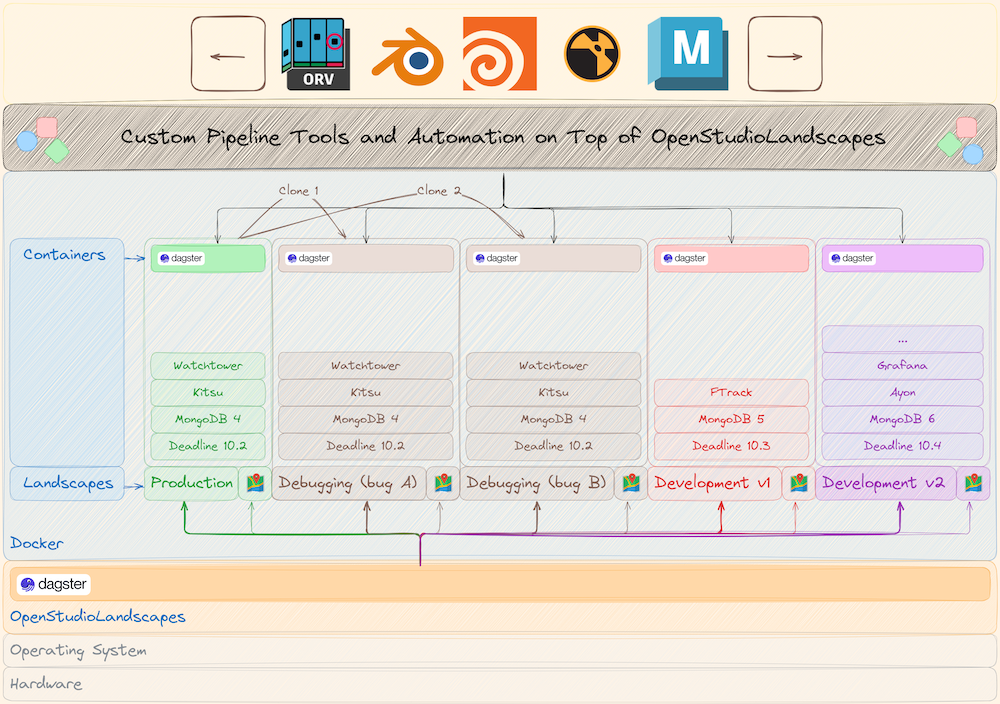
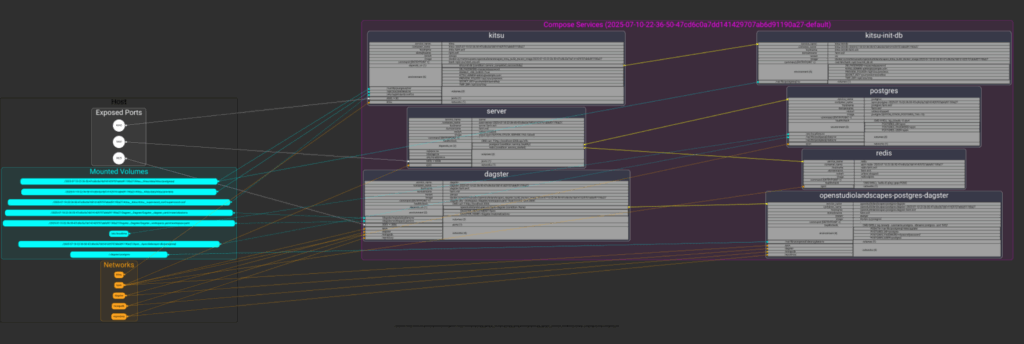
The term I came up with for such a collection of studio services is “Landscape” (with the labels “Production”, “Debugging (bug A)” etc.). OpenStudioLandscape creates an overview (a map) for each individual Landscape so that you can keep track of what’s going on (the map icon on the above schema):
What is your own experience with these challenges?
My own experience has mostly been a pretty frustrating one. Whoever I worked for, there have always been solutions at work that don’t follow best practice approaches. The learning curve to be able to deal with this fact can be quite substantial. Furthermore, in some cases, this even led to situations where standard tools (like an IDE for example) could not function properly. And eventually, instead of fixing the underlying issue caused by custom solutions, most of the time I saw fixes on top of the issues, leading to even more frustration. And I haven’t even gone down the poor-documentation-rabbit-hole.
Who would benefit the most from this platform?
There are different ideas I have in mind. First of all, TD’s or developers living in areas with a very low large-studio-density will have trouble finding a job. So I thought, what if there was a way – and artists have been doing that for a long time – to freelance as developers. Now, usually this is a tricky thing to do because the tools and infrastructures individual studios use are so different to the extent that knowledge is not easily transferable. This could be changed though, by basically consolidating the system, these tools are being deployed with. A developer can easily support different studios that use the same platform.
Second, as mentioned, animation and VFX students work with pretty decent pipelines (depending on the university of course). However, once they leave uni, they – in many cases – are left with nothing to work with. In case they want to team up with the buddies from school, they have to set up their own collaboration platform which requires its own unique set of skills. In both scenarios, OpenStudioLandscapes can open up these closed doors.
You’re offering this for free to anyone who’d find it useful. How long has it taken you to build this, from idea, to inception, and why have you decided to offer it for free?
The idea grew over the years, however, by total accident, only about a year ago I got to know Dagster. I started to play around with it and was fascinated by its simplicity and power. The next important piece of the whole puzzle I’ve been diving into was Docker. These two open source tools are key to my OpenStudioLandscapes project.
OpenStudioLandscapes is free and open source – and always will be. I started the development of OpenStudioLandscapes and all its Features in December 2024.
“The reason why I decided to offer it for free is this: since I’ve started with 3D animation I’ve been learning from people who share their knowledge – for free in many, many cases. I am not creative enough to share what I’ve learned with DCC tools, but I can share what I’ve learned as a TD and developer. I wanted to give something back to the community based on my own skillset.”
How do you hope this will benefit the industry overall?
I feel like there is a big gap between very small studios and very large studios. Short answer: I want to bridge that gap. I want to see more small studios, i.e. doing indie projects with professional tools. I want to see a way more diverse animation and VFX industry landscape than what we currently have: the small ones are limited due to technical challenges and the big ones becoming bigger.
Could other industries use this platform?
OpenStudioLandscapes is basically a deployment platform to set up different collections of services. All services that I have been dealing with so far could be turned into Features (OpenStudioLandscapes term for “a studio service as a pluggable module”). That said, yes, other industries with similar tech related unhealthy-growth-issues could use this system to prevent tech dept.
What has been the general feedback so far?
A few people have reached out and are interested. At first, it can be a bit challenging to grasp what OpenStudioLandscapes is and what it can do for them. I’m working on building a community – on LinkedIn mostly – to provide constant updates. Getting the system up and running is not yet as trivial as I would like it to be. Overall, OpenStudioLandscapes together with all its Features – not even to speak of the underlying technology like Docker or Dagster – is pretty complex. I’m constantly working on lowering the barrier. But it’s still a long way. However, I’m working on creating custom Landscapes for two small studios in animation/VFX and games.
Is the platform finalised, or is there an ongoing development plan?
To be realistic: the project is never finished because whatever service could be dockerized could be turned into an OpenStudioLandscapes Feature. There are a few key Features in my opinion that make the system useful to begin with:
– Production Tracking (for example Kitsu)
– Individual Pipeline and Automation (for example Ayon or Dagster)
– Secure and fine grained access (verified certificates, SSL, Multi Factor Authentication etc.) for collaborators to web resources in distributed projects with Teleport (freelancers accessing your local Kitsu Production Tracking for instance)
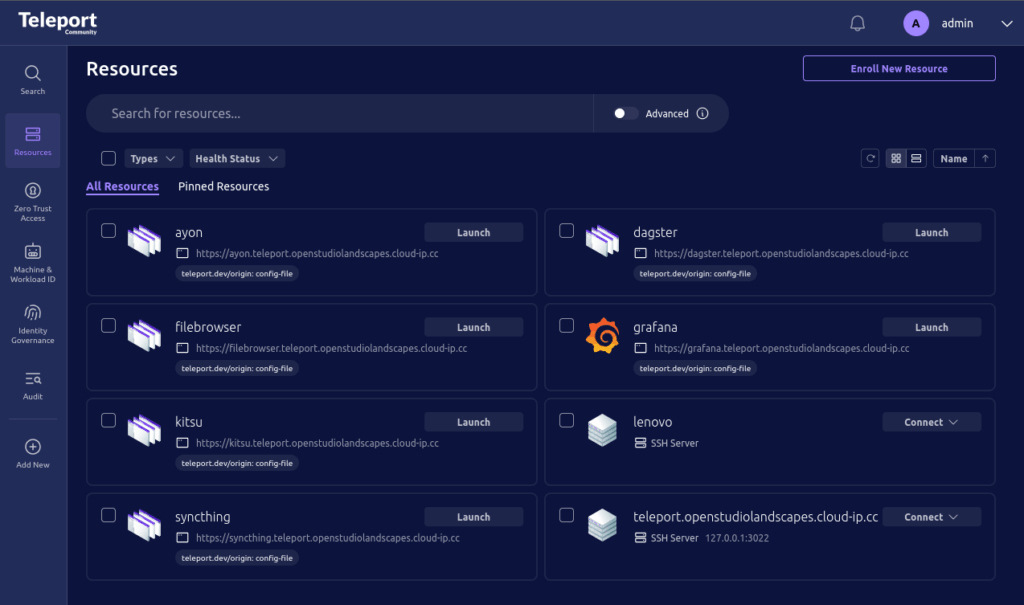
All these key Features (and more) have been successfully modularized and are available for Landscape creation. As mentioned above, other key elements are lowering the barrier and improving documentation – also ongoing.
How has or is this project helping develop your own skills or growth?
Well, my learning curve has been steep enough to say the least. So, in that sense, I have developed my Dagster, Docker and Python skills in different aspects. Some that I most overlooked until recently are Python packaging and tools like nox for example. Without these, managing a large project like OpenStudioLandscapes and all its Features (17 to date), is merely impossible without getting lost. To give you a number: my GitHub Contributions to (mostly) OpenStudioLandscapes since January 1 2025 range between 5500 and 6000 – even for myself, this is hard to believe!
What other positive outcomes would you like to see as a result of your work on this project?
I would like to see OpenStudioLandscapes being implemented and being adopted by the community. On top of that – because I still lack experience in many fields of software development – it would be nice to see skilled people jumping on board to support the project. As a long term goal, maybe, it would be very satisfying to see OpenStudioLandscapes listed on the ASWF Projects website.
What’s your advice for those currently out of work and/or lacking career motivation currently?
My advice would be to see the down time as an opportunity to work on your own projects (be it CG or something entirely different). Whatever you do, you’ll learn something and your backpack of skills keeps getting bigger. Working in a structured environment (a regular job for example) can also prevent you from learning new stuff! Maybe team up with others with down time and work on something together – maybe THIS is going to be your next gig! In case you lack motivation, take it as a sign and change the environment entirely. If the visual environment is going to be missed, you’ll end up back there sooner or later 😉
Can people still get involved in this project and if so how?
The project is open both for contributors as well as for people that are interested in setting up (or have it set up for them) a custom Landscape.